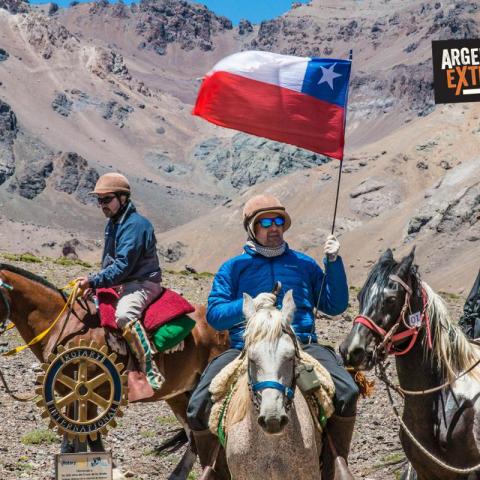
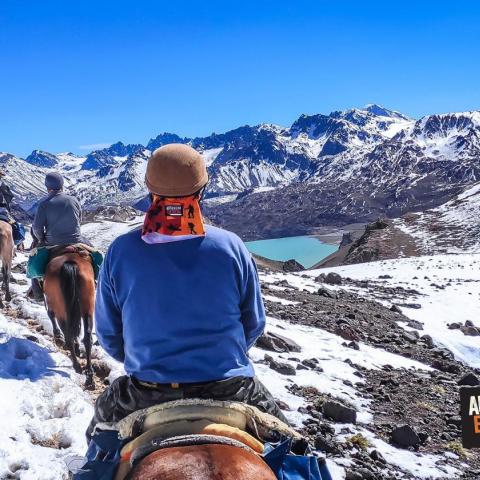
No one doubts that crossing the Andes is a heroic experience. But today, crossing the mountain range on horseback can become a summer adventure within everyone's reach. Winding through valleys, waterfalls, volcanoes and glaciers, our Travel team completed the southern horseback crossing linking Argentina and Chile, and came back to tell the story. Crossing the Andes through the southern part of the province is an experience suited to everyone. The faint of heart should abstain: you'll be standing before some of the most wonderful landscapes you've ever seen. Maybe you're drawn by the epic of San Martín. Maybe you're passionate about backpacking. Maybe the fact that the guide makes you leave your watch, phone, iPod or any other gadget behind connects you with the feeling of being truly cut off. But think about it: can you picture yourself crossing the mountain range on horseback on a seven-day trek? It doesn't get any better than this: Malargüe offers a ride that, in the end, weaves together an internal and external challenge from which (we found out by the finish) you can't help but come out changed.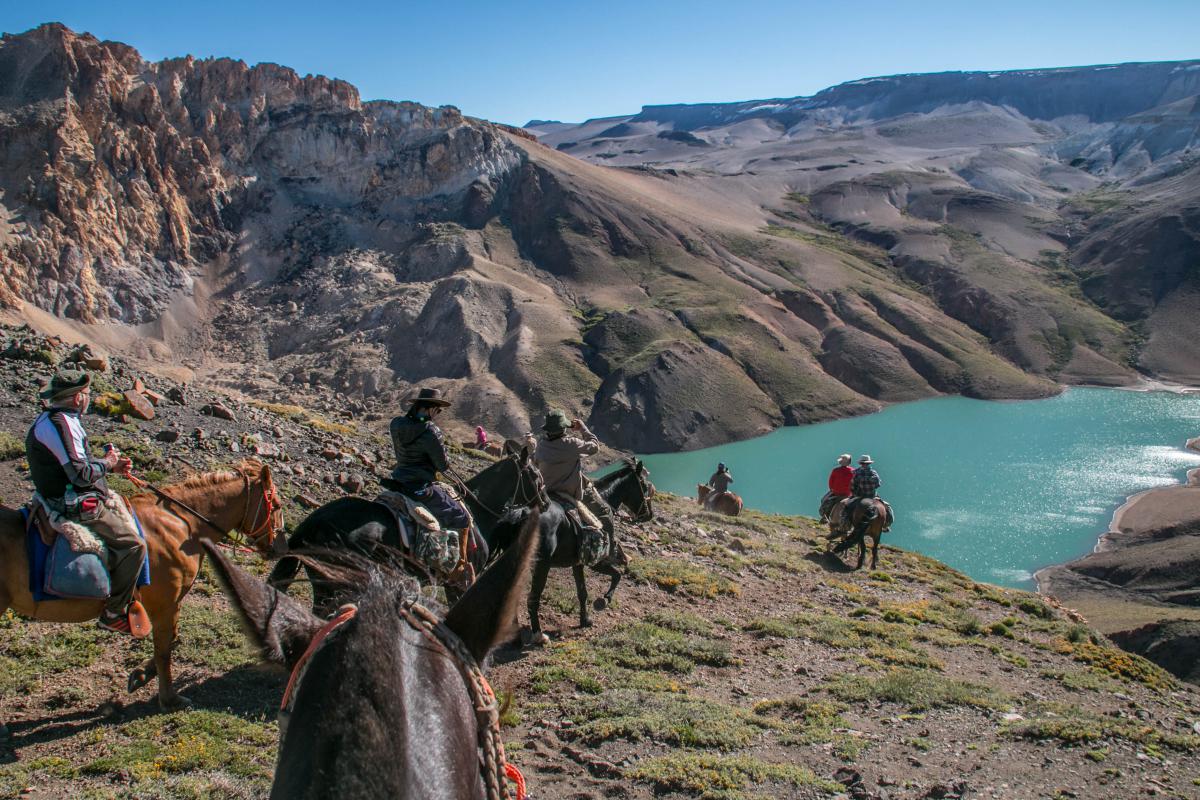
So those of us who were sold met up at a hostel downtown, point "a" of an adventure we knew almost nothing about (horses, yes; mountains, yes) except that word of mouth and the internet rated it "excellent".
Shortcut #1: Only the guide has the GPS-tracked route memorized -almost 200 kilometers on horsepower alone, along a circuit that, at one point, takes us across into Chilean soil- crossing crags, waterfalls, mountain meadows and glaciers, with no trace of human presence anywhere.
From the start, the group turned out to be an eclectic bunch: a traveling couple from inland Buenos Aires province, a gym teacher, an orthopedist, a Barcelonan set on climbing, a lawyer and a journalist. Almost all of us were inexperienced or had zero experience with horses. "95% of the people who come here have never ridden before", the guide reassures us, "but watch: many end up turned into riders by the end". And that was the first truth he told us.
Empanadas, a transfer and saddling up in Las Loicas. "Why don't I have a 360° view?, sighs one traveler as she climbs the first hill to the west. True enough: after three hours in the saddle, arriving at the Vega de Los Pacos meadow, everything familiar melts away. Let's just say: it's not the vast, arid mountain, nor the monotony of the thorny desert. Instead, there's a strange floor of white ash and an intensely green valley where herds of horses graze in the open. "They're free", the local guides say, "though they do have an owner".
First night, camp. The sky? The clearest on this side of the world (which is why, as it happens, the Pierre Auger Observatory sits in Malargüe), a festival of constellations that has us laying our sleeping bags out under the open air. At dawn, mate in hand, watching the herd.
"We're entering the lost city", the guide says quietly, perhaps aware of the awe that this stone village in the middle of nowhere always inspires. Rocks reshaped by water and wind. A kind of reef in the mountains. "Yes...I want that 360 view". Nearby, we'd hit the ride's first big adrenaline rush. "Anyone not up for it, stay on the trail", he suddenly calls out ahead. "Anyone who is, follow me". All of us but one, plus the pack handlers, threw ourselves down the Trolón descent (some 800 meters dropping at a grade of just over 45° over pure volcanic ash), burying the vertigo and the cold right there. The valley kept piling on beauty and joy: jokes, a campfire, a waterfall in the background and a run of cliffs lining either side of the river. "Did you ever get bored?", a friend asks, hearing the story. How could we! Picture a landscape that changes with every step (it truly never repeats itself, since in many stretches the eroding rock dominates, forming shapes that mimic organic ones, a memory of what was once a seabed). Every so often, one or two condors. A mountain caracara. A few rufous-collared sparrows skimming past the horses. A gentle trot to the excursion's highest point (2,935 m), where the landmark marking the border between Argentina and Chile stands. "Notice we're riding over a glacier", Alaniz points out. It's true, there's snow beneath the cracked ash as well.
Shortcut #2: 40 kilometers from the landmark lies El Planchón Pass, one of the five mountain passes the Liberating Army once used. From there, the Planchón and Peteroa volcanoes come into view.
"Shall we gallop?" Adrenaline builds among the group, now moving as one with their horses. Eventually we head back to the Trolón valley, which, as it happens, held a perfect waterfall at its far end. Fuel for a seven-hour day in the saddle.
"Ah, 360... to take in a panorama of the waterfalls, the Pichi Trolón, the streams, the caves". Even the "Castronero's Cave", which we make our way to slowly.
Shortcut #3: A "castronero" is the person in charge of tending the castrones - that is, isolating and keeping watch over the male goats to prevent mating before the optimal date. He typically spends whole seasons in the mountains, with only FM Malargüe radio for company, living in the cave that bears his name. "Greetings, Don Julio."
Country cooking and a good trot. The journey brought sun and a few drops ("a witch is getting married", as the saying goes) and sun again. Spontaneously, at the Pichi Trolón, a hike breaks out across slopes scattered with wildflowers and loose rock. The descent is fast, of course, because Laguna del Negro is waiting. "Wait...this descent is going to be interesting", the guide warns, before launching into the outlaw legend of the "Dead Man's Descent", the lagoon's final challenge (a lagoon with gulls and ducks in the middle of the mountains!) whose shores would invite our first gallop. We didn't shout out of fear. Nor only out of wonder. We also let out, quite healthily, the kind of exclamations no ordinary trip would call for. Because the mountain range, whatever the sea might think, is no ordinary trip. Definitely not. At Laguna del Negro we watch the sun set behind Cerro Campanario. And even more of the Milky Way from the shore.
By the fifth day, the expedition members have become creatures of the landscape. "We don't want to go back anymore", they joke, half seriously. This time, though with a bit less intensity, we saddle up to head back, though we still have a day ahead of us at the Cajón Grande hot springs.
Shortcut #4: Run by an entire family, the Cajón Grande lodge has room for 24 guests and plenty of open ground for camping. In summer, the draw is the peace of the place, home-cooked meals and the healing waters (there are hot springs at 35°, 40° and 47°C); in winter, it's backcountry skiing for a crowd of athletes looking for a little more solitude.
Cajón Grande, then, left us at the mercy of some well-earned leisure that, though broken up by rustic beauty treatments like algae scrubs, kept promising a chivito on the grill. Our last night in the mountains, which stirred up longing for another Malargüe ride. In fact, we were already starting to miss the horse. Because the animals had surrounded us with their spirit, and our guides had opened a door onto an unseen world. We woke to sopaipillas, kneaded by our hosts, to brace us for a day charged with emotion. And so we said goodbye to a south so full of sound and sight that no words in this world could ever fully capture it.