Little is known about a plane crash in the south of Mendoza province, in the El Sosneado area. There, a Transamerican company plane headed for Central America crashed in May 1960 with 9 people aboard, counting passengers and crew.
Several years later, it was discovered that this flight was carrying a significant sum of money and jewelry that wasn't declared to customs, and that some local ranch hands got hold of that loot. It became popularly known as “the dollar plane.” Today we'll tell its story.
1) Source: Diario Los Andes
Mysterious flight
On the morning of Tuesday, May 17, 1960, from Ezeiza airport in Buenos Aires province, a Transamerican cargo plane with registration LV-GGJ departed bound for Panama — via the Pacific — with a stopover in Chile beforehand. A total of 5 passengers and 4 crew members were aboard that flight. In addition, in the plane's cargo hold, it was carrying 7 thoroughbred horses and several suitcases.
At 11 in the morning, the engines of the Curtiss C-46 started up, and it departed westward an hour behind the estimated flight plan. Along the way, the plane flew over the skies of Junín (Buenos Aires) and then crossed a large part of the Argentine pampas heading west.
It was 2:30 pm when the pilot made his last radio contact with the San Rafael control tower and reported that, due to the delay, he would not be able to land there and that he would try to cross the Andes mountain range at the Paso del Yeso an hour later. That was his last communication. The aircraft began to be shaken by strong turbulence that prevented it from climbing to about 6,000 meters above sea level. Despite the pilot's desperate attempts, the “Curtiss” suddenly descended and crashed into a mountain.
After a few hours with no news of the plane, the San Rafael operator alerted the rescue units of the 4th Air Brigade, who immediately set out to search the vast area from Cristo Redentor to the mountain region of Neuquén without finding any trace.
A few hours later, the list of passengers and crew traveling on the flight was released: Sergio Etcheverry, Carlos Luján, Pedro Puccineri, Omar Silva and Raúl Díaz. Pilot Luis Alberto Lapuente, Fermín Gómez (co-pilot), Oscar Carballo (navigator), and onboard mechanic Domingo Vacarell.
The search by land and air continued until the end of May in the hope of finding the remains of the aircraft.
An unbelievable discovery
After the last rescue parties exhausted every chance of finding the C-46, the search was called off, dashing hopes of finding the aircraft or any survivor.
In July 1961, word reached the authorities that a local ranch hand named Eduardo Gutiérrez had found the plane's wreckage.
In San Rafael, Gutiérrez was questioned by the local police. He said that near Cerro El Sosneado he located the wreckage of the missing plane and two lifeless bodies of the passengers. The information he provided led to an expedition being organized for that November.
Searching for the Transamerican
At dawn on November 21, 1961, a rescue commission set out for El Sosneado, under the command of the head of the National Gendarmerie Squadron, chief commander Pedro Fernández. The patrol was made up of 24 gendarmes, 7 provincial police officers, and 3 experts from the Aviation Accident Investigation Board.
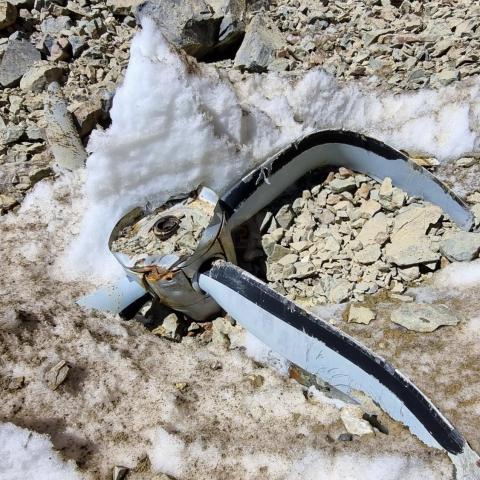
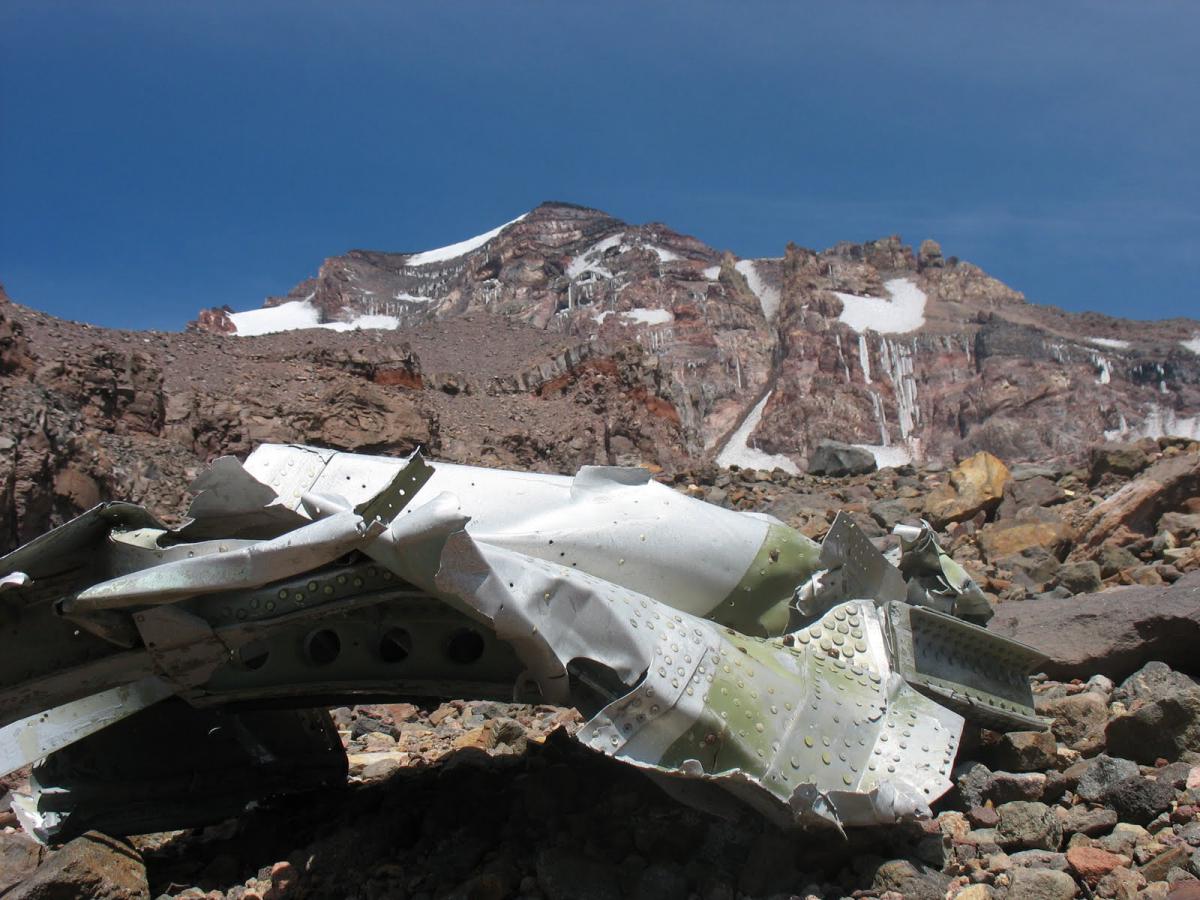
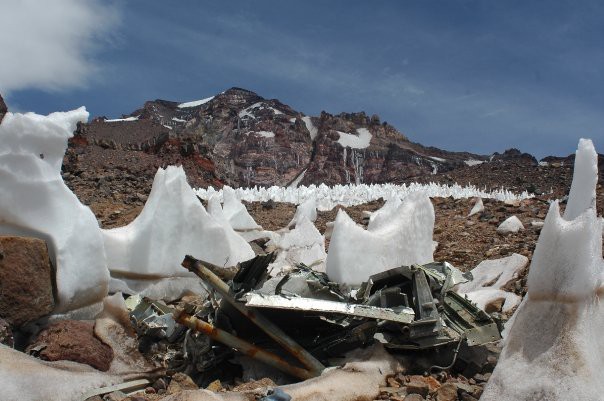
The expedition set out guided by the local ranch hand Eduardo Gutiérrez. The team had to face several obstacles but managed to reach where the aircraft had gone down. The team was unable to recover the victims' remains because part of the wreckage was covered in snow. On site, the aeronautical investigators collected some pieces in order to figure out how the accident had happened. The expedition returned due to poor weather conditions that prevented the recovery of the bodies.
A bleak picture 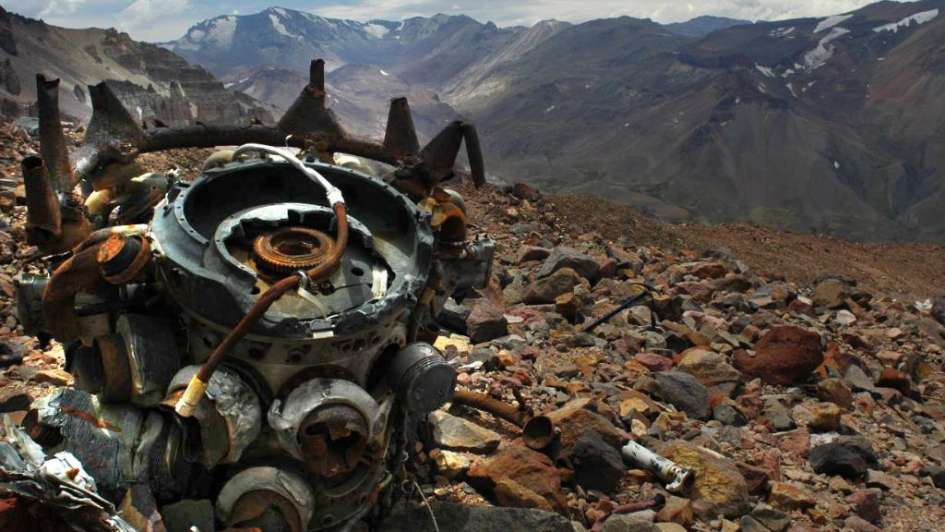
A few months later, in March 1962, another expedition set out. Its main objective was to recover the bodies, some belongings, and to study the causes of the crash. After an exhausting climb, they reached an altitude of 4,500 m, where they found some pieces of the wing, wood fragments and a wheel from the plane.
Within a 3-kilometer radius, part of the fuselage was found, along with the bodies of the unfortunate passengers, crew, and also of the horses that had been traveling in the cargo hold. A wristwatch, documents, passports and other belongings.
The rescuers gathered the bodies and transported them on mules to the ranch station of "El Sosneado." There, other personnel were waiting, and they loaded the remains into 9 coffins to be transported to Buenos Aires.
Aviation experts determined that the cause of the accident was severe turbulence that dragged the plane into the mountain, and the case was closed.
They stole, they fled, and they got caught
A few years later, the San Rafael police received a report stating that five local ranch hands had found cash, jewelry and gold coins in the mountains.
At first the officers didn't think much of it, but suspicions were later confirmed when they discovered that one of those involved had wallpapered one of the walls of his house with U.S. banknotes. It was also found that these individuals had improved their financial situation very quickly, buying new cars, businesses and equipment for their properties.
Further investigation revealed something surprising about the Transamerican flight: the plane was carrying approximately 500,000 dollars, along with jewelry and gold coins, in several suitcases that had not been declared at the airport's customs office, confirming that these valuables had been smuggled.
In October 1972, police arrested Julio Guzmán, Raúl Rivero Rojas (from the "El Sosneado" ranch station), Víctor Manuel Arteaga and Jaime Rojas; all of them confessed to the theft. Some time later they were found guilty and imprisoned for having taken the money and jewelry from that air disaster.
2) Source: Diario del Neuquén:
Elena Lapuente reveals details of the accident her father was involved in, in the Andes mountain range.
"My father crashed the plane because he felt invincible; he was a good pilot, but he got overconfident," says Elena Lapuente as she looks through old photographs in the dining room of her house in the Provincias Unidas neighborhood.
Lapuente had been an air force officer who fought alongside President Juan Domingo Perón in the resistance against the so-called Revolución Libertadora. He was the pilot of the presidential plane and one of many officers and leaders who ended up imprisoned for their Peronist sympathies.
 "He was in prison for two years and spent an entire winter in the Ushuaia jail," Elena recalls with nostalgia.
Along with her mother and two sisters, she received letters and drawings from her father from the southernmost prison in the world, where the cold was unbearable and the chances of survival were nearly nil. Due to the respiratory illnesses they suffered there, authorities decided to transfer all political prisoners to Buenos Aires. In Magdalena, Elena, her mother and sisters were able to have direct contact with him until Lapuente was finally released in 1957. From that moment on, everything would change for him, since he would never be able to work as a military officer again.
A television factory gave him his first job as a civilian, one he didn't much care for, but it provided the support he needed to keep his family. Fate had it that a few months later he managed to get hired as a pilot at the Transamerican transport company, which flew from Argentina to destinations such as Panama and Miami.
They handed us a sealed coffin with the promise not to open it for 20 years. Later they gave us an urn with my father's ashes." Elena Lapuente
On May 17, 1960, a Curtiss C46 plane under Lapuente's command departed from Buenos Aires bound for Panama (via the Pacific) carrying 13 thoroughbred horses. A crew of 13 people accompanied him.
After flying several hours crossing Argentine territory from east to west, he tried to land at Mendoza airport, where he was told that weather conditions were unfavorable due to a heavy snowstorm and that he needed to refuel in San Rafael, although that airport wasn't operational either.
In his last communication with the control tower, Lapuente reported that he would try to reach Chile through the Paso del Yeso, despite the recommendations he received over the radio not to cross.
"That day, a friend called me to tell me that my dad's plane had gone missing in the mountains," recalls Elena, who was 16 years old at the time. Elena and her sisters broke down in tears, but their mother tried to comfort them with her enormous religious faith: "Don't cry, because if God wanted it this way, He'll know why."
Hours and days passed with no news of the plane. Lapuente's wife decided to sell the family's car and raise all the money needed to hire local guides to help with the search. The Air Force and several foreign planes that had arrived from other countries to take part in celebrations for another anniversary of the May Revolution joined the search, but they found nothing.
"We spent two years not knowing what had happened," Elena says. Until, in March 1962, the thaw made it possible to discover the wreckage of the crashed plane on a mountain near El Sosneado, a small spot near Malargüe. A local ranch hand found the wreckage and reported it to the police. After an exhausting climb, the rescue patrol found part of the aircraft at 4,500 meters of altitude. Within a 3-kilometer radius, they found more pieces of the plane, the bodies of the victims, and of the thoroughbred horses.
The curious thing is that, after the case was closed, an anonymous tip alerted police that this man had wallpapered his shack with U.S. banknotes, and that, not recognizing American currency, he'd used the paper to cover the cracks in the walls and protect himself from the cold. It was also reported that other people in the area had spent fortunes on cars, homes and even small plots of land, and had even sold gold coins and jewelry.
But where had such a huge amount of money come from?
After an investigation and the subsequent confession of the ranch hands, it was established that all those banknotes had been in the hold of the crashed plane.
It was never known exactly how much money the Curtiss C46 was carrying on that trip. "A lot of things were said; even that the plane was a courier for Perón, carrying his fortune into exile," Elena admits.
As the years went by, the legend of El Sosneado and that mysterious flight only grew. The myth has grown to the point that there are travel agencies in Mendoza that run tours up that steep mountain to see the remains of the "dollar plane" and hear, again and again, the tragic story starring Commodore Lapuente.
The art of a political prisoner
During the winter he spent imprisoned in the Ushuaia jail for having supported Perón, Commodore Lapuente sent several letters to his family, along with drawings he made in his cell. In one of them, the officer perfectly depicted the dimensions of the prison and the layout of its wings. Alongside the drawing, you can see the signatures of Peronist leaders who were with him, such as Alberto Cámpora, Antonio Cafiero and Jorge Antonio, among others.
His daughter, Elena Lapuente, treasures those original drawings and her father's accounts of his time in prison.