Man has always admired birds and wanted to fly like they do. That is, until we finally arrive at the experiments of brothers Joseph and Étienne Montgolfier. They invented the Montgolfière, the first hot air balloon, which was inflated with hot air. On June 5, 1783, they achieved their triumph by flying a hot air balloon in the main square of Annonay. Pilâtre de Rozier and the Marquis d'Arlandes had the honor of being the first men to soar through the skies in a Montgolfier balloon, on October 21, 1783. In our country, the novelty arrived later, and it began to be used in different celebrations, but only with small paper balloons filled with hot air. The earliest records date back to May 26, 1809, when a fairly large, unmanned balloon was launched from Plaza de la Victoria in honor of King Fernando VII's birthday. Many balloons were launched afterward, but only on holidays, and none were meant to be manned.
Space needed for assembly, takeoff and landing
A hot air balloon has an average height of 27 meters and a diameter of 16 meters — practically a 6-story building made of fabric. To assemble and later launch it, an area of about 50 x 50 meters is needed, free of obstacles. Ideally, the site should have trees around its perimeter to provide shelter from the wind.
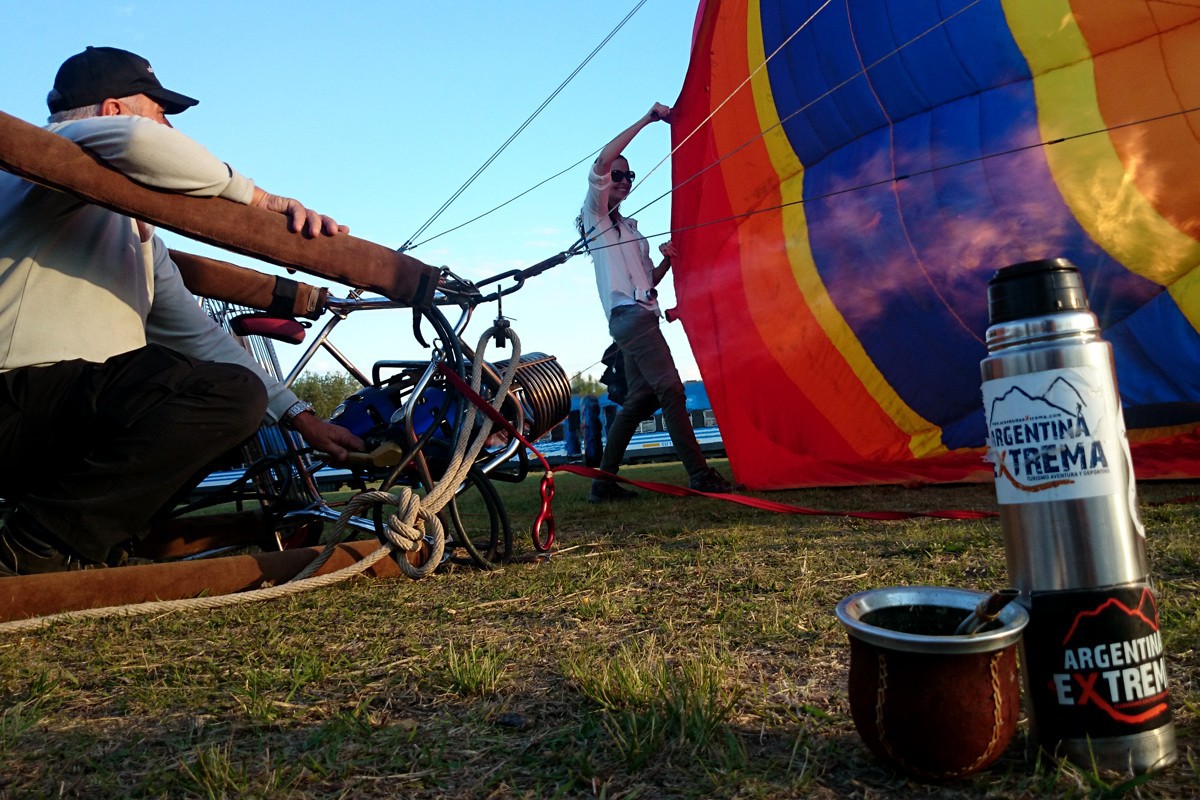
Preparation time for assembly ranges from 30 to 45 minutes, during which the public can approach and take part in the assembly and flight process.
A hot air balloon has 3 main components: Basket – Burners – Envelope (fabric)
- Number of people it can carry
Depending on the size of the balloon, 2 to 4 passengers can travel per flight.
The balloon flies through a temperature difference: with 1° more inside it will start to rise, and with 1° less it will start to descend.
To keep a level flight, the pilot keeps the temperature constant by continuously operating the burners.
A 27-meter-tall balloon generally holds around 3,000 m3 of hot air.
3,000 m3 of hot air at a temperature of 15°, at sea level, equals a lifting force of 500 kg free. 3,000 m3 of hot air at a temperature of 30°, at sea level, equals a lifting force of 250 kg free.
If the pilot already knows the flying area, they can anticipate where they will land based on wind direction. The balloon flies for a distance of 10 to 15 km, after which the support crew, in a pick-up truck and in radio contact, follow it to the landing site.
Mooring lines are set up in a triangle shape, which allows the balloon to rise in the same spot. This way the public can experience a brief flight.
At events, ascents are made to a height of 15 meters so that guests or the general public can experience a balloon ascent.
Autonomy is generally 2 hours. To keep it inflated longer, a propane gas refill must be planned.
Around the world, balloons usually carry the colors of a country, a company, an organization, etc.
Marketing creatives have also come up with balloons shaped like products or animals. Basically, anything round can fly!!!
Thanks to their visual appeal, major cities around the world now include “Hot Air Balloon Competitions” in their annual calendar. For example, the World Championship held in the city of Saga, Japan, draws 1,000,000 spectators.
They are also held in the USA, Canada, Russia, France, Spain, and Brazil. Argentina does not yet have a scheduled event calendar.