Let me explain the category system for mountain sunglasses, which is essential for safety at high altitude:
Why are categories used?
Mountain sunglasses are classified into categories because the intensity of UV radiation and visible light increases dramatically with altitude. For every 1,000 meters of elevation, UV radiation increases by roughly 10-12%.
Category 0 - Very Light Filter
: 0-19% of light
Use: Indoors, very overcast days
Mountain: Not recommended
Category 1 - Light Filter
Absorption: 20-56% of light
Use: Overcast days, soft light
Mountain: Only for dense forests or very overcast days
Category 2 - Medium Filter
Absorption: 57-81% of light
Use: Moderate sunlight
Mountain: Hiking at low elevations, partly cloudy days
Category 3 - Dark Filter
Absorption: 82-92% of light
Use: Intense sunlight
Mountain: Standard for most activities (up to about 3,000m)
Category 4 - Very Dark Filter
Absorption: 92-97% of light
Use: Extreme conditions
Mountain: Mandatory for high altitude, glaciers, snow
Snow Reflectance:
Fresh snow reflects up to 80-90% of UV radiation
It creates a "solar oven" effect that can cause temporary snow blindness
Altitude and Atmosphere:
At higher altitude, less atmosphere filters the radiation
Above 3,000m: Category 4 is nearly mandatory
Glaciers: Always Category 4
Sun Angle:
In the mountains you receive direct + reflected radiation
A "double exposure" effect from above and below

By Altitude:
- 0-1500m: Category 2-3
- 1500-3000m: Category 3
- 3000m+: Category 4
- Glaciers/Snow: Always Category 4
By Activity:
- Hiking: Category 2-3
- Mountaineering: Category 3-4
- Ski mountaineering: Category 3-4
- Expeditions: Category 4
CE Certification:
- Sunglasses must comply with the EN ISO 12312-1 standard
- It guarantees UV protection up to 400nm
- Categories are standardized internationally
UV Protection:
- UV-A (315-380nm): Penetrates deeper into the skin
- UV-B (280-315nm): Causes burns
- UV-C (100-280nm): Filtered by the atmosphere (not relevant at high altitude)
Insufficient Category:
- Snow blindness (corneal burn)
- Premature cataracts
- Macular degeneration
- Temporary or permanent blindness
Excessive Category:
- Difficulty seeing terrain details
- Greater risk of accidents
- Eye strain
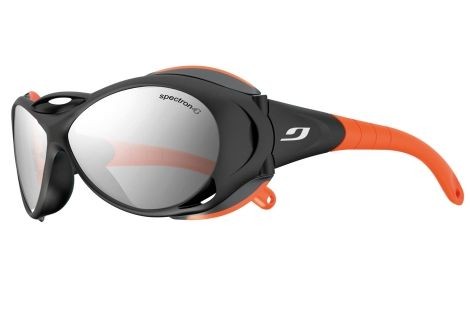
For the mountains, the ideal is to bring two pairs:
Category 3: For approaches and normal conditions
Category 4: For high altitude, glaciers and snow
The category system exists because in the mountains we need to protect our eyes - temporary snow blindness forces us to abandon the expedition, and without assistance it leaves us exposed to accidents.