Legend has it that the Pilcomayo and Bermejo rivers were born from the blood and tears of two siblings, TuviChavé and Michiveva, children of the god Tupá. When both turned into rivers, the Gran Chaco was left without a chief, but it kept thriving under the care of nature, tangled, impenetrable, crossed by both rivers. And so it remains, without a doubt, where the province of Formosa now lies.
Where to begin a tour of Formosa's nature? Without a doubt, the La Estrella wetland is a good choice. In this area, near Las Lomitas, the mighty Pilcomayo river overflows from time to time and floods low-lying areas, from which the water never fully drains before the next flood.
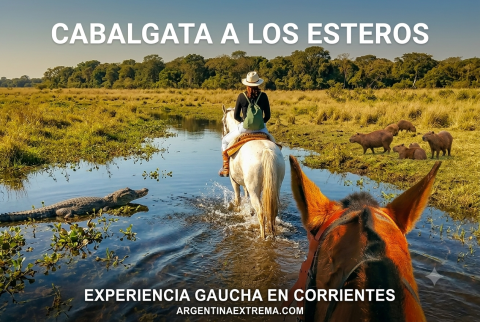
This natural cycle created and sustains the third-largest wetland in South America. Its 400,000 hectares act as a great water reservoir, and where there is water there is biodiversity. That's why this green world lets you observe large concentrations of species — threatened, endemic and migratory — that are hard to see in other ecosystems. You'll find everything from crested caracaras, herons and ducks to caimans, capybaras, giant otters, anteaters and tamanduas, tapirs, jaguars and the curious maned wolf, among many other animals. And all this while strolling among alders, caranday palms, cattails, carob trees, quebracho and palo santo trees.
Different ethnic communities settled in this rich ecosystem — mainly Pilagá, Wichí and Toba — who today preserve many of their traditions and values, adding an interesting cultural dimension to a visit to the area. Here the main activities are livestock farming, agriculture, forestry, fishing, hunting and the gathering of certain plants such as chaguar, seeds or bark, which people know how to dye and use to craft elaborate handicrafts.
The world of birds
Another reserve worth visiting is Laguna Oca, less than 10 minutes from downtown. It's a set of lagoons and streams home to about 300 bird species — also a site recognized by BirdLife International — where you can rent bicycles and boats for a quiet outing, or simply enjoy a good day in the shade of a thatched hut on a sandy beach along the Paraguay river.
The tour can well end in Herradura, a town on the shore of the lagoon of the same name and the area's fishing hub: every summer it hosts the National Corvina Festival, and every May, the Piranha Festival, with fishing contests, exhibits and various activities. If you've never tasted a pacú empanada, you can stop by the La Florencia complex, which besides its picturesque cabins has a barbecue area, a lagoon and an 11-hectare park perfect for hiking, birdwatching, fishing and playing soccer, basketball or volleyball.
On strolls along its beautiful lagoon, the songs of the birds that love the ambay, timbó and ingá trees, which form the gallery forest along the rivers and streams, are a great delight. High up in the canopy, you may even catch sight of the famous black-and-gold howler monkeys.