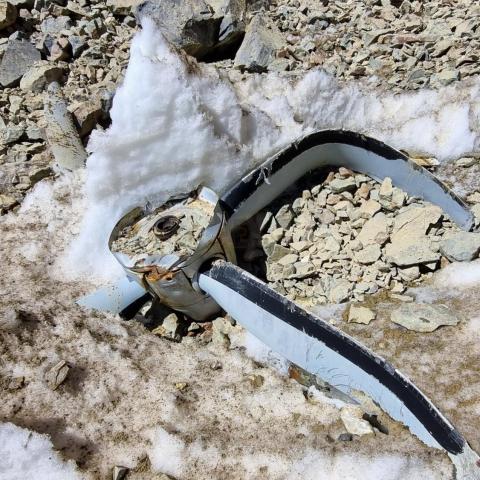
Many years ago now, with our group calling ourselves the Herrantes, we set out to enjoy nature with passion. We have carried out a great many expeditions, some on our own and others with the help of specialized guides. We climbed the Lanín and Domuyo volcanoes in Neuquén; Plaza Francia on Aconcagua, San Bernardo in Mendoza, and several others.

We managed to reach an altitude of 6000 m on the San Francisco volcano in Catamarca, which marked an emotional milestone for all of us. But something was still missing, something that would move us to our core, beyond the grandeur, the difficulty, the natural beauty. Then an idea came up that had lived inside me for years, something I needed to experience in the very place where it happened: reaching the site where, for more than 70 days, in the worst imaginable conditions, a group of human beings — young people for the most part, athletes — survived after suffering a terrible plane crash in the Andes mountain range; that place is found at the Glacier of Tears, at 3,610 meters of altitude, and it was where the most remarkable survival miracle I can recall took place. The seven members of our team, Juan, Aldo, Antonio, Jorge, Gabriel, Ángel and I, with our guide Iván, set out very early in the morning from the refuge near the abandoned El Sosneado hotel, in the Malargüe department, in the south of Mendoza province.
On our hike we had to cross the Atuel River, which in the first days of December was running quite full. We crossed the river on horseback with the invaluable help of the local guide Vicente. After more than eight hours of climbing, during which we also had to cross several rapids on foot, we reached the refuge where we would stay for two nights at 2,500 meters of altitude, not before fording the Barroso, a river that comes rushing down from the mountains with very cold water. We had to change our footwear with each crossing, since the idea was not to stay wet for long given the water's very low temperature. We rested as much as we could, and the next day we set out before dawn toward our destination. It was more than seven hours of climbing, including another river crossing, and the last stretch was very hard, with a lot of loose rock at an angle of nearly 45 degrees, until we reached the ridge from which you can see the monolith placed on a hilltop in homage to those involved in the crash. We even had to cross snow tongues for about 500 meters before reaching that spot. Once we arrived at the iconic site, we were all left speechless, overcome and deeply moved, trying to imagine these people fighting for their lives, without proper clothing, without water or food, without any kind of experience, in the worst weather conditions; and we drew a brief comparison with ourselves, with a mountain guide, with specialized clothing, water and food, and a controlled route and schedule. They had even set out into the unknown trying to cross the mountain toward the west, which is an almost vertical wall. We all thought along the same lines, and we came to the conclusion that we could not fully grasp how they achieved such a tremendous feat. Heroes, brave souls, and a thousand more adjectives, which I would sum up in the following phrase: “Courage is not the absence of fear, but the strength to keep moving forward despite fear.” We will never forget it.