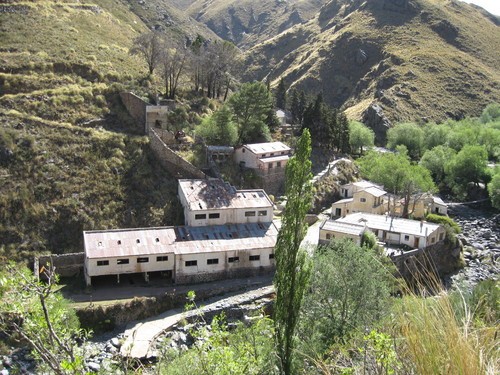
The area is rugged and lives up to its name: Cerro Aspero (Rough Hill). It can be reached on foot or by off-road vehicle. It lies about 60 km west of the Embalse Nuclear Power Plant, in the province of Córdoba, and 20 km east of Villa de Merlo, in San Luis. The tungsten extraction and processing facilities of Pueblo Escondido were located at the confluence of three mountain streams, whose waters were vital for washing the ore, which was extracted without the use of any chemical products.
In its heyday, Pueblo Escondido was home to dozens of workers, milling, concentration and mineral-separation facilities using mechanical methods, its own power plant, a hospital, housing for miners and foremen, and a telephone line. There was also a 300-meter-long cable tramway to bring the ore down to the plant, and a fuel station, among other facilities. But there was no geologist on site. There were, however, expert miners, many of them brought in from Chile and Bolivia.
Tungsten is rare in the Earth's crust. In nature it is never found pure, but combined with other elements, forming two types of minerals called scheelite and wolframite. The mine at Cerro Aspero produced wolframite, which contains iron, tungsten and manganese. Wolframite is black in color, with a metallic look and shine.
Geologist Jorge Sfragulla, of the School of Exact, Physical and Natural Sciences at the National University of Córdoba, tells the story of the mine's origins: “The deposit was discovered in 1894 by Guillermo Bodenbender, one of the founding fathers of Argentine geology. He was a German geologist who came as a disciple of Luis Brackebusch, whom Sarmiento had brought to the Academy of Sciences of Córdoba during his presidency. Bodenbender lived in Argentina for 58 years and his body of work was vast.”
“The Cerro Aspero mine operated from the late 19th century until 1969. It closed as the international price of tungsten dropped, while at the same time the higher-quality ore was running out. But the deposit's death sentence came with the entry of the People's Republic of China into the world tungsten market in the 1980s. Today, 85 percent of the tungsten used by global industry comes from China, 5 percent from Russia, 3 percent from Canada, and the remaining 7 percent from a handful of other countries,” Sfragulla adds.
Before the Chinese surge, Argentina was a tungsten exporter. At that time, around 70 percent of national production came from the Concarán area, in San Luis, while the remaining 30 percent was extracted in Córdoba.
In our country, tungsten ore is found forming “eyes” a few centimeters across, embedded in quartz veins — extremely hard rock up to a meter thick. For that reason, extraction was done through galleries dug into the rock, which followed the vein down to depths of 35 meters. They were blasted with dynamite. Even today some of these galleries can still be found with their entrances open. By contrast, in China tungsten ore is carried along by rivers, which makes it much cheaper to obtain.
But the use for which tungsten is truly considered strategic is in the production of steel alloys highly resistant to heat and impact, for the arms industry. For example, armor plating for vehicles and artillery shells. The peak of global demand for tungsten, which brought Pueblo Escondido its greatest period of activity, occurred during the Second World War.
To leave no doubt about this, Sfragulla shows a revealing chart: Argentina's tungsten production in tons over the years. The peaks coincide with the eras of the great wars: the First World War (1914-1918), the Second (1939-1945), the Korean War (1950-1953), the Vietnam War (1965-1975). The absolute peak corresponds to the Second World War, with more than fifteen hundred tons produced and exported by our country in a single year.
But all of that is history now. Pueblo Escondido changed its pace decades ago. The feverish bustle of miners in the dark galleries gave way to the footsteps of hikers seeking mountain silence. And so, the technological oasis that had flourished to the beat of war drums has regained its peace.